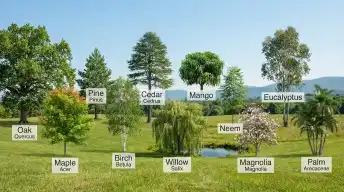
If you are looking for types of trees with names, you will find familiar trees such as oak, maple, pine, birch, cedar, willow, elm, mango, neem, apple, walnut, and eucalyptus. Trees can be grouped in several ways, including by their leaves, growth habits, habitat, flowers, fruit, and seeds.
The word “type” can mean different things in a tree guide. A tree may be called deciduous because it loses its leaves seasonally, evergreen because it keeps foliage for more than one growing season, or coniferous because it produces cones.
This guide brings together common tree names and useful categories so you can understand what makes each group different.
Common Tree Names
Here are some familiar tree names you may see in forests, gardens, parks, streets, farms, and other landscapes.
| Tree Name | Scientific Name | Simple Feature |
| Oak | Quercus | Produces acorns |
| Maple | Acer | Often has lobed leaves |
| Pine | Pinus | Has needles and cones |
| Birch | Betula | Often has pale bark |
| Cedar | Cedrus | Evergreen conifer |
| Willow | Salix | Often grows near water |
| Elm | Ulmus | Broad spreading crown |
| Ash | Fraxinus | Has compound leaves |
| Beech | Fagus | Often has smooth gray bark |
| Walnut | Juglans | Produces walnuts |
| Eucalyptus | Eucalyptus | Aromatic leaves |
| Magnolia | Magnolia | Known for large flowers |
| Poplar | Populus | Often grows quickly |
| Spruce | Picea | Evergreen with cones |
| Fir | Abies | Cone,bearing evergreen |
| Redwood | Sequoia / Sequoiadendron | Can grow extremely large |
| Neem | Azadirachta indica | Evergreen tree of South Asia |
| Mango | Mangifera indica | Produces mangoes |
| Apple | Malus | Produces apples |
| Olive | Olea europaea | Produces olives |
Common names are useful for everyday conversation, but they can vary between regions. Scientific names provide a more precise way to identify a particular tree.
Types of Trees by Leaf Behavior
One simple way to classify trees is by what happens to their leaves during the year.
Deciduous Trees
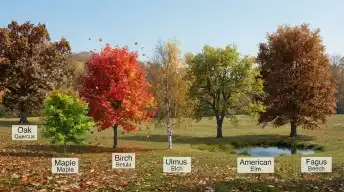
Deciduous trees lose their leaves during a particular season. Many species lose their leaves in autumn, but the timing depends on the species and local climate.
Common deciduous tree names include:
- Oak
- Maple
- Birch
- Elm
- Beech
- Ash
- Poplar
- Aspen
- Willow
- Cherry
- Walnut
Many deciduous trees become easy to recognize when their leaves change color before falling.
For example, several oak, maple, birch, ash, and walnut species are deciduous, although the exact behavior depends on the species.
Evergreen Trees
Evergreen trees retain living foliage for more than one growing season. They do not normally drop all their leaves at the same time.
Common evergreen tree names include:
- Pine
- Fir
- Spruce
- Cedar
- Juniper
- Cypress
- Holly
- Eucalyptus
- Olive
- Some magnolias
Evergreen does not mean that the leaves never fall. Older leaves still drop as part of the tree’s normal growth cycle.
Coniferous Trees
Coniferous trees are cone,bearing seed plants. Many have narrow needles or scale,like leaves.
Common examples include:
- Pine
- Spruce
- Fir
- Cedar
- Juniper
- Cypress
- Redwood
- Larch
Pine trees belong to the genus Pinus. Spruce trees belong to Picea, while fir trees belong to Abies.
Most familiar conifers are evergreen, but not every conifer keeps its foliage throughout the year. Larch, for example, is a conifer that loses its needles seasonally.
Broadleaf Trees
Broadleaf trees generally have wider and flatter leaves than trees with needle,like foliage.
Examples include:
- Oak
- Maple
- Birch
- Beech
- Elm
- Ash
- Walnut
- Magnolia
- Poplar
- Apple
- Cherry
Many broadleaf trees are deciduous, but some broadleaf species remain evergreen.
This means broadleaf and deciduous do not mean the same thing. Broadleaf describes leaf form, while deciduous describes seasonal leaf loss.
Fruit,Bearing Trees
Fruit trees are trees that produce fruits people may eat or use for food products.
Common fruit tree names include:
- Apple
- Mango
- Orange
- Lemon
- Guava
- Fig
- Peach
- Plum
- Cherry
- Pomegranate
- Olive
- Avocado
- Jackfruit
- Coconut
- Date palm
Apple Tree
Apple trees belong to the genus Malus. They are widely cultivated for their edible fruit.
Mango Tree
The mango tree is ** Mangifera indica **. It grows mainly in tropical and subtropical regions and produces mangoes.
Olive Tree
The olive tree, ** Olea europaea **, produces olives and is strongly associated with Mediterranean agriculture.
Fig Tree
Fig trees belong to the genus Ficus. The common fig is ** Ficus carica ** and is cultivated for its edible fruit.
Flowering Trees
Flowering trees produce flowers as part of their reproductive cycle. Many are also planted because of their attractive blooms.
Popular flowering tree names include:
- Magnolia
- Dogwood
- Cherry
- Redbud
- Jacaranda
- Crabapple
- Frangipani
- Golden shower tree
Some flowering trees are also fruit trees. Cherry and apple trees, for example, can be valued both for their spring flowers and their fruit.
Magnolia
Magnolias are known for their large, noticeable flowers. Different species can have different flower colors, shapes, and blooming seasons.
Dogwood
Dogwoods include several species and are popular ornamental trees. Their flowers or flower,like structures can make them easy to notice in spring.
Jacaranda
Jacaranda trees are widely known for their purple or violet,colored blooms and are commonly planted in warm climates.
Tropical Trees
Tropical trees grow naturally in warm regions, although each species has its own climate and moisture needs. Some are important for food, timber, shade, or landscaping.
Common tropical tree names include:
- Mango
- Coconut
- Neem
- Banyan
- Jackfruit
- Tamarind
- Teak
- Mahogany
- Kapok
- Breadfruit
- Guava
- Rubber tree
- Papaya
- Cocoa tree
- Baobab
Mango Tree
Mango (Mangifera indica) is a well,known tropical fruit tree. It produces mangoes and grows well in warm climates.
Neem Tree
Neem (Azadirachta indica) is an evergreen tree native to the Indian subcontinent. It is widely known across South Asia and is commonly planted around homes, roads, and farms.
Banyan Tree
Banyan refers to several trees in the genus Ficus. Banyans are known for aerial roots that can develop into additional supporting trunks.
Jackfruit Tree
Jackfruit (Artocarpus heterophyllus) is a tropical tree that produces large fruits. Its fruit can be eaten at different stages of ripeness.
Teak Tree
Teak (Tectona grandis) is a tropical hardwood tree. It is especially known for its valuable wood.
Dry,Climate and Desert Trees
Some trees can survive in places where rainfall is limited. These trees often have features that help them handle heat, drought, or dry soil.
Examples include:
- Acacia
- Mesquite
- Khejri
- Date palm
- Palo verde
- Tamarisk
- Desert willow
- Olive
- Some eucalyptus species
Khejri Tree
Khejri (Prosopis cineraria) is an important tree of dry regions of South Asia. It is particularly associated with arid and semi,arid landscapes.
Acacia
Acacia is a large group of trees and shrubs. Many species are adapted to dry environments, although acacias also grow in other habitats.
Date Palm
Date palm (Phoenix dactylifera) is widely cultivated in hot, dry regions for its sweet fruit.
Olive Tree
Olive (Olea europaea) is well adapted to Mediterranean,type climates. It produces olives used as food and for oil.
Tree Names With Scientific Names
Common names can sometimes create confusion because the same name may be used for different plants. Scientific names provide a more precise way to identify individual species.
Here are some familiar examples:
| Common Name | Scientific Name |
| White oak | Quercus alba |
| Red maple | Acer rubrum |
| Sugar maple | Acer saccharum |
| Paper birch | Betula papyrifera |
| River birch | Betula nigra |
| American beech | Fagus grandifolia |
| White ash | Fraxinus americana |
| Black walnut | Juglans nigra |
| Eastern redbud | Cercis canadensis |
| Flowering dogwood | Cornus florida |
| Tulip tree | Liriodendron tulipifera |
| Eastern white pine | Pinus strobus |
| Colorado blue spruce | Picea pungens |
| American elm | Ulmus americana |
| Common fig | Ficus carica |
| Mango | Mangifera indica |
| Olive | Olea europaea |
| Neem | Azadirachta indica |
A common name can describe a broad group, while a scientific name can identify a particular species.
50 Types of Trees With Names
Here is a quick list of tree names from different groups:
- Oak
- Maple
- Pine
- Birch
- Cedar
- Willow
- Elm
- Ash
- Beech
- Walnut
- Spruce
- Fir
- Cypress
- Juniper
- Redwood
- Magnolia
- Dogwood
- Cherry
- Apple
- Pear
- Peach
- Plum
- Mango
- Orange
- Lemon
- Guava
- Fig
- Olive
- Pomegranate
- Coconut
- Date palm
- Neem
- Banyan
- Tamarind
- Teak
- Mahogany
- Eucalyptus
- Acacia
- Mesquite
- Poplar
- Aspen
- Sycamore
- Chestnut
- Hickory
- Ginkgo
- Jacaranda
- Rubber tree
- Kapok
- Khejri
- Baobab
This list includes trees from different practical groups rather than treating every group as a separate scientific classification.
How to Identify a Tree by Its Features
Knowing a tree’s name is useful, but identifying an unfamiliar tree usually requires looking at several features together.
1. Examine the Leaves
Leaves are one of the easiest features to observe.
Look at:
- Shape
- Size
- Color
- Leaf edges
- Number of lobes
- Arrangement on the branch
- Needle,like or broad shape
For example, many maple species have distinctly lobed leaves, while pine trees have needle,like leaves.
2. Examine the Bark
Bark can provide another useful identification clue.
Notice if the bark is:
- Smooth
- Rough
- Furrowed
- Peeling
- Thick
- Thin
- Light,colored
- Dark,colored
Some trees have distinctive bark, but bark alone should not always be used to identify a species.
3. Look at Flowers
Flowers can help identify flowering trees, especially when the tree is in bloom.
Check:
- Flower color
- Flower size
- Number of petals
- Flower shape
- Time of blooming
- if flowers appear alone or in clusters
Magnolia, cherry, dogwood, and jacaranda can often be recognized more easily when they are flowering.
4. Check the Fruit or Seeds
Fruit, nuts, and seeds can provide strong clues.
For example:
- Oak → acorns
- Pine → cones
- Maple → winged seeds
- Walnut → walnuts
- Apple → apples
- Mango → mangoes
- Date palm → dates
However, not every tree produces something that is immediately recognizable as a fruit.
5. Look at the Tree’s Shape
The overall shape of a tree can also help.
Some trees have:
- Tall, narrow crowns
- Wide spreading branches
- Drooping branches
- Rounded crowns
- Column,shaped growth
- Multiple trunks
Willows, for example, are often associated with long, hanging branches, while many conifers have more narrow or pyramidal shapes.
6. Consider the Habitat
Location can narrow down possible tree species.
Ask:
- Is the tree growing near water?
- Is the area very dry?
- Is the climate tropical?
- Is it growing in a cold region?
- Is it planted in a city?
- Is it growing naturally in a forest?
A tree’s natural range can be an important clue, but planted trees can grow far outside their native regions.
Easy Tree Names for Beginners
If you are learning tree names for school, gardening, nature study, or general vocabulary, start with familiar examples.
Simple Tree Names
- Oak
- Pine
- Maple
- Birch
- Cedar
- Willow
- Elm
- Ash
- Fir
- Spruce
- Palm
- Mango
- Apple
- Cherry
- Walnut
These names are easier to recognize and appear frequently in basic tree guides.
Less Common Tree Names
Some tree names are less familiar but useful for expanding your vocabulary.
- Ginkgo
- Zelkova
- Catalpa
- Jacaranda
- Liquidambar
- Parrotia
- Phellodendron
- Cercidiphyllum
- Sequoia
- Baobab
- Kapok
- Khejri
- Tamarack
- Hornbeam
- Persimmon
These names can refer to particular genera or species, so scientific names are helpful when you need exact identification.
Why Do Trees Have Different Names?
Trees can have several names because people in different regions and languages may use different terms for the same plant.
A tree may have:
- A common English name
- A local name
- A regional name
- A traditional name
- A scientific name
For example, mango is the familiar English common name, while Mangifera indica is its scientific name.
This difference is one reason botanical references often provide both names.
Can One Tree Belong to More Than One Type?
Yes. Tree categories can overlap.
For example, a mango tree can be described as:
- A fruit tree
- A tropical tree
- A broadleaf tree
- An evergreen tree
An oak can be described as:
- A broadleaf tree
- A deciduous tree in many species
- An acorn,producing tree
A pine can be described as:
- A conifer
- Usually an evergreen
- A cone,producing tree
So, “types of trees” does not always mean separate groups with no overlap. The same tree can fit several descriptions based on the feature being discussed.
Tree Names by Their Most Noticeable Features
Tree names become easier to remember when you connect each one with a feature that makes it recognizable.
Trees Known for Their Flowers
- Magnolia
- Dogwood
- Cherry
- Jacaranda
- Redbud
- Crabapple
- Golden shower tree
These trees are often planted for their attractive flowers and seasonal displays.
Trees Known for Their Fruit
- Mango
- Apple
- Orange
- Lemon
- Guava
- Fig
- Peach
- Plum
- Cherry
- Olive
- Pomegranate
Fruit trees vary greatly in size, leaf shape, climate needs, and growing habits.
Trees Known for Their Large Size
- Redwood
- Giant sequoia
- Eucalyptus
- Banyan
- Kapok
- Baobab
Some of these trees can reach impressive sizes, but the exact height and spread depend on the species, age, and growing conditions.
Trees Known for Their Distinctive Bark
- Birch
- Paperbark maple
- Sycamore
- Cork oak
- Eucalyptus
Bark can change as a tree grows, so it works best as one part of an identification process rather than the only clue.
Popular Trees for Gardens and Landscapes
Many trees are grown around homes, parks, streets, schools, and public spaces.
Popular landscape tree names include:
- Maple
- Oak
- Birch
- Dogwood
- Magnolia
- Cherry
- Crabapple
- Redbud
- Cedar
- Cypress
- Palm
- Jacaranda
The right tree for a particular location depends on factors such as climate, soil, available space, sunlight, water, mature size, and local planting conditions.
A tree that grows well in one region may not perform well in another.
Trees Commonly Associated With Forests
Forests contain many different tree species, and the species found in a forest depend heavily on climate and geography.
Examples of familiar forest trees include:
- Oak
- Maple
- Beech
- Birch
- Pine
- Spruce
- Fir
- Aspen
- Elm
- Chestnut
- Hickory
- Redwood
Some forests are dominated by broadleaf trees, while others contain mostly conifers. Mixed forests can contain both.
Trees With Needles
Needle,like foliage is strongly associated with many conifers.
Common examples include:
- Pine
- Spruce
- Fir
- Larch
- Yew
Their needles are not all the same. They can differ in length, thickness, arrangement, and color.
For example, pine needles often occur in bundles, while spruce needles grow individually from the branches.
Trees With Broad Leaves
Many familiar trees have broad, flat leaves.
Examples include:
- Oak
- Maple
- Birch
- Beech
- Elm
- Ash
- Walnut
- Magnolia
- Poplar
- Apple
Leaf shape can vary significantly between species, so broadleaf trees should not be identified by leaf width alone.
Trees That Grow Near Water
Some trees are commonly associated with rivers, streams, wetlands, or other moist environments.
Examples include:
- Willow
- River birch
- Cottonwood
- Bald cypress
- Black alder
- Poplar
The presence of water can be a useful identification clue, but it does not prove a particular species. Many trees are planted in places outside their natural habitats.
Trees for Shade
Large trees are often planted to provide shade around homes, parks, streets, and public spaces.
Examples include:
- Oak
- Maple
- Beech
- Elm
- Plane tree
- Sycamore
- Banyan
- Rain tree
When selecting a shade tree, mature size matters. A tree that starts small may eventually develop a wide crown and require considerable space.
Trees With Edible Nuts
Some trees are valued for their nuts or edible seeds.
Examples include:
- Walnut
- Almond
- Hazelnut
- Pecan
- Chestnut
- Pistachio
- Cashew
These trees belong to different botanical groups, so “nut tree” is mainly a practical food,related category rather than one single botanical family.
Trees Commonly Used for Timber
Some trees are important sources of wood.
Examples include:
- Teak
- Oak
- Mahogany
- Pine
- Cedar
- Spruce
- Fir
- Walnut
- Maple
- Eucalyptus
Different species produce wood with different properties. Wood uses can include construction, furniture, flooring, paper, tools, and other products.
The fact that a tree produces useful timber does not make it a separate botanical type. It describes one of its human uses.
Quick Tree Type Comparison
| Tree Type | Examples | Main Feature |
| Deciduous | Oak, maple, birch | Lose leaves seasonally |
| Evergreen | Pine, cedar, eucalyptus | Retain foliage for multiple seasons |
| Coniferous | Pine, spruce, fir | Produce cones |
| Broadleaf | Oak, maple, beech | Usually have broad leaves |
| Fruit tree | Mango, apple, orange | Produces edible fruit |
| Flowering tree | Magnolia, dogwood, cherry | Produces noticeable flowers |
| Tropical tree | Mango, teak, banyan | Common in warm climates |
| Dry,climate tree | Acacia, khejri, olive | Adapted to relatively dry conditions |
| Nut tree | Walnut, pecan, almond | Produces edible nuts or seeds |
| Timber tree | Teak, oak, pine | Commonly valued for wood |
These categories can overlap. For example, an oak can be both a deciduous broadleaf tree and a timber tree.
How Many Types of Trees Are There?
There is no single simple number for the phrase “types of trees.” The number depends on what “type” means.
If you mean species, there are thousands of tree species around the world. If you mean broad categories, trees can be grouped in many practical ways, such as deciduous, evergreen, coniferous, broadleaf, flowering, fruit,bearing, tropical, and dry,climate trees.
Botanical classification is more precise than these everyday categories because it organizes plants according to their evolutionary relationships and scientific taxonomy.
What Is the Difference Between a Tree and a Plant?
A tree is a type of plant, but not every plant is a tree.
Trees generally have a persistent woody structure and usually develop a main trunk or several woody stems. However, there is no single worldwide botanical definition based only on height or trunk size.
Some plants that look tree,like may technically belong to groups with different growth forms.
This is why terms such as tree, shrub, palm, and woody plant should not always be treated as exact scientific equivalents.
How to Choose the Right Tree Name
If you are choosing a tree for a garden, property, school project, story, or naming list, start with the purpose.
For a Shade Tree
Consider:
- Oak
- Maple
- Elm
- Beech
- Plane tree
For a Flowering Display
Consider:
- Magnolia
- Dogwood
- Cherry
- Redbud
- Jacaranda
For Fruit
Consider:
- Apple
- Mango
- Orange
- Lemon
- Guava
- Fig
For Warm Climates
Consider trees such as:
- Mango
- Neem
- Coconut
- Tamarind
- Jackfruit
Always check if a species is suitable for your local climate before planting it.
Frequently Asked QuestionsFAQs
Q1: What are the most common types of trees?
Common types include deciduous, evergreen, coniferous, broadleaf, flowering, fruit-bearing, tropical, and dry-climate trees.
Q2: What are 10 common tree names?
Oak, maple, pine, birch, cedar, willow, elm, ash, mango, and eucalyptus are common tree names.
Q3: What are examples of deciduous trees?
Oak, maple, birch, beech, ash, elm, poplar, and many willow species are examples of deciduous trees.
Q4: What are examples of evergreen trees?
Pine, spruce, fir, cedar, juniper, eucalyptus, olive, and some magnolia species are evergreen trees.
Q5: What are some common fruit tree names?
Apple, mango, orange, lemon, guava, fig, peach, plum, cherry, olive, and pomegranate are common fruit trees.
Q6: What are some flowering tree names?
Magnolia, dogwood, cherry, redbud, jacaranda, and crabapple are well-known flowering trees.
Q7: What are examples of tropical trees?
Mango, coconut, neem, banyan, jackfruit, tamarind, teak, mahogany, and breadfruit are examples of tropical trees.
Q8: What are coniferous trees?
Coniferous trees are cone-bearing plants. Common examples include pine, spruce, fir, cedar, juniper, and cypress.
Q9: How can you identify a tree?
Check its leaves, bark, flowers, fruit, seeds, branches, overall shape, and growing environment. Using several features gives a more reliable identification.
Q10: Why do trees have scientific names?
Scientific names provide a more precise way to identify trees because common names can differ between regions and languages.
Conclusion
There are many types of trees with names, and each group can be understood through features such as leaves, flowers, fruit, seeds, bark, climate, and growth pattern.
Some familiar examples are oak, maple, pine, birch, cedar, willow, mango, neem, eucalyptus, magnolia, apple, and walnut. Trees can also belong to several groups at once. A mango can be a tropical, evergreen, broadleaf, and fruit,bearing tree, while a pine is generally an evergreen conifer.
For accurate identification, common names are helpful, but scientific names provide greater precision. When you are unsure about a tree, compare several physical features and consider where the tree grows.
Read More About !

Hi, I’m Olivia Hayes, and I love discovering cute, creative, funny, and unique names. I enjoy exploring playful naming ideas that help people find something different from ordinary choices. Whether you need a cute pet name, a fun nickname, or a creative name idea, I enjoy making the search more exciting.








1 thought on “Types of Trees With Names: 50 Common Tree Names & Types”